Puglia is one of the top producing wine regions in Italy in terms of production. As we continue to build upon what we’ve covered the last couple weeks, covering most of Puglia’s wine appellations, this week we cover the red grapes of Puglia. Ifyou’re a lover of rich, full-bodied, ripe fruit driven wines then Puglia is for you.
The most widely planted red grapes of Puglia you may most be familiar with are Primitivo and Negroamaro, but there are also some other lesser known and rediscovered grapes like Bombino Nero, Nero di Troia and Susumaniello that you’ll find across the region. Of course, you’ll find many other red grapes to include Montepulciano, Sangiovese, Malvasia Nera and Aleatico. Let’slook at a few of them.
Primitivo
Primitivo is a grape that is genetically identical to Zinfandel and is also grown in Croatia under the name CrljenakKasteljanski. The name comes from the Latin word Primitivus, which means early ripening. The grape clusters contain thin skinned, small berries that can ripen unevenly. We talked about two areas to discover this grape last week, Primitivo di Manduria and Gioi del Colle. Primitivo di Manduria is in the Taranto province in southern Italy and the Primitivo of this area produces wines that have intense color, big, rich, high alcohol driven wines with ripe, jammy flavors. Its counterpart, Gioia del Colle, is located inland in the Bari province and creates Primitivo wines that are fresher and more elegant.
Sourced from the Consorzio dei Vini Gioia del Colle
Negroamaro
Negroamaro is the other grape that competes with Primitivo for most of Puglia’s attention. It is found mostly in the Salento province and produces both red and rosé wines. Negroamaro means “black bitter”, which doesn’t sound too attractive in my opinion, but these wines are far from bitter. Just the opposite! They also have an intense color that carries high acidity and firm tannins along with ripe fruits and spices. They are often blended with Malvasia Nera to help soften it. Negroamaro grapes produce good yields, do well in the heat and in fighting against fungal diseases and are resistant to droughts.
Sourced from Tenute Rubino
Bombino Nero
Bombino Nero stands for the “little black bomb” of Puglia’s lesser-known grapes, although it can be found in 1 of Puglia’s 4 DOCG appellations, Castel del Monte Bombino Nero DOCG, where it is produced exclusively as a rosé.These black, thinly skinned grapes don't reach optimal ripeness, therefore the wines tend to produce wines that are fresh with high acidity and red fruit notes, different than what Puglian grapes are typically known for, fruit bombs.
Sourced by Consorzio Vini DOC Castel del Monte
Nero di Troia
Also known as uva di troia, Nero di Troia also occupies one of Puglia's other DOCG appellations with the Castel del Monte Nero di Troia Riserva DOCG. It's named after the town of Troia from which it is grown. This can be a difficult grape to grow and is highly susceptible to diseases with low yields. Its purple colored, thick-skinned grapes ripen late and produce flavors of red and black fruits with spice, high alcohol and good acidity and tannins.
It’s time to revisit southern Italy to the region of Puglia, also known as Apulia, and highlight it’s primary red grape, Negroamaro. We’ll be exploring one of the prominent wineries of the region, Cantele, located along the Salento peninsula.
The Puglia wine region is at the southern tip on the heel of Italy’s boot shape. It’s a land with a vast amount of plains and has an abundance of olive groves and farmland that is rich in agriculture along with a rocky coastline full of beaches. Located between the Ionian and Adriatic Sea, it’s the ideal Mediterranean climate that receives ample sunshine with moderating cooling breezes off the Seas along with the Sirocco winds blowing up from the south from Africa.
The history of Puglia winemaking was first heavily influenced and established mostly by the Greeks. They refined winemaking and planted vineyards. The winemaking of Puglia continued to prosper once the Romans took over.
The Puglia wine industry has a history of producing grapes and selling them off to northern Italy. Facing the cooler, Alpine climate, the wines of the north resulted with a lack of color and alcohol. This is where Puglia’s grapes are able to help improve the wines of the north in the areas lacking. This continued until about the 90’s when wineries and winemakers of Puglia started to look inward focusing on improving the quality of their own wines. Puglia ranks among the top 3 wine regions in Italy in terms of volume.
The Winery ~ Cantele
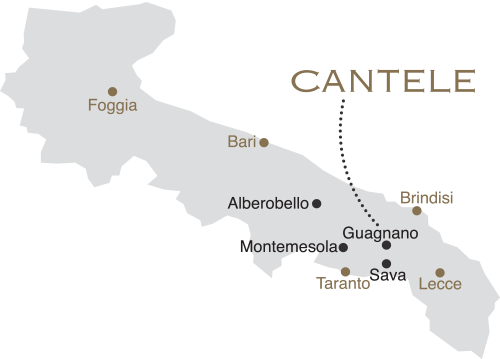
This is where Cantele comes into play. Cantele is located in the Salento peninsula, a narrow strip of land in southern Puglia. Giovanni Battista Cantele moved from northern to southern Italy in Puglia after World War 2 where him and his wife, Theresa, fell in love with the area of Lecce. He started off as many others did at the time selling off their grapes to the North.
In 1979 one of Giovanni’s two sons, Augusto, established the winery along with his father and brother Domenico. Augusto had studied winemaking in the north in Conegliano and later returned to Puglia consulting in the area before purchasing vineyards for the winery. Their focus is on “minimal intervention” to allow the grapes to show themselves in the purest form and display freshness.
As of 2001 Cantele is operated by the 3rd generation, the children of Domenico and Augusto. Gianni and Paolo are the children of Augusto and Umberto and Luisa, Domenico’s children. They grow many of Puglia’s native grapes including Negroamaro, Primitivo, Susumaniello and White Malvasia along with Chardonnay on their 120+ owned vineyards and the other 370 acres they manage.
The Wine
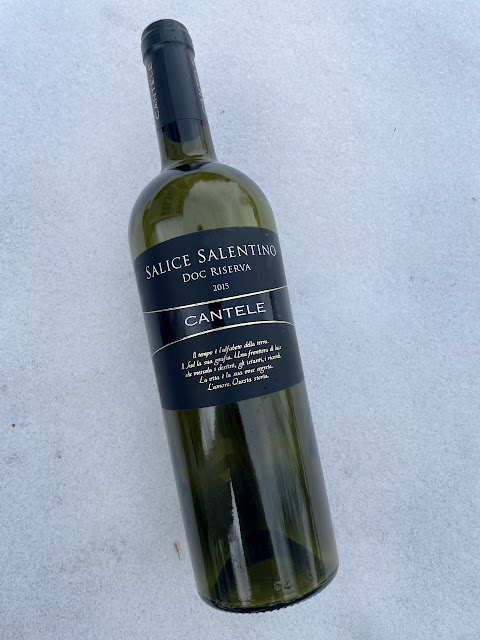
The 2015 Cantele Salice Salentino DOC Riservais made of 100% Negroamaro. The locals call the Negroamaro grape “Niuru Maru”, which translates to bitter black. It is a dark, thick -kinned grape that produces rich, fruit forward wines. This wine is considered a benchmark, classic wine for Cantele with sourced grapes from their top parcels.
The Salice Salentino DOC was established in 1976 and takes it's name after the city where it was established. Located in the Lecce and Brindisi province, the Salice Salentino DOC require at least 80% of the Negroamaro grape, some using 100% as the one displayed today. Up to 20% of other grapes may include Malvasia Nera di Brindisi and/or Malvasia di Lecce.
The grapes from Cantele’s Salice Salentino DOC Riserva are grown from 20-50 year old vines on calcareous and clay soil. The wine spends 6 months in French barriques. Garnet in color and partially translucent in the glass. An abundance of berries on the nose including cherries, black raspberry and blackberries. Medium bodied with a nice blend of red and black lush raspberries and blackberries. Fruit forward with a hint of cedar and vanilla backed by acidity. An overall smooth and soft wine full of fruit.
Happy New Year! It's hard to believe another year has passed us by. Vino Travels is welcoming our 5th year anniversary. I apologize for the lack of blogging in comparison to other years, but as all my dedicated readers know we have just welcomed our 2nd son into our family in November and another little guy of 18 months running around so to say the least I have my hands full.
I
came in contact through networking with a winery in Puglia, Cantina
Primo Re, that is just starting out from the ground up with their
first release this coming spring. Typically I won't share stories of
a winery I haven't visited or met with representatives of the winery
and/or at the least tasted their wines. I thought it would be
interesting though in sharing this story and learning about the
trials and tribulations of one couple's story. Enjoy!
Tell
me about the history of winemaking in Nicola’s family and his
background & experience in enology.
Nicola’s
family has been producing grapes at least five generations. His
father had always worked at the family vineyards working with the
primitivo and negroamaro grapes, selling them to a local cooperative.
Nobody in his family had ever produced wine, apart from small
quantities reserved for the family.
Nicola
Nicola grew up “between the vines” but
soon decided that being a winegrower wasn’t enough for him. This is
the reason he moved to Tuscany and later to Piedmont to study
viticulture & enology science, which in Italy is a 5 year degree
(Bachelor + Master). His Bachelor degree at Florence concluded
with work at the prestigious winery,
Barone Ricasoli. His Master
degree in Piedmont increased his knowledge of fine wines such as
Barolo and Barbaresco. At
the university he also worked on a project to improve the quality of
the barbera grape and his thesis on infrared spectrophotometry was a
significant success.
Nicola graduated from the university at the beginning of winter so
he moved to Argentina where it was harvest time and worked for a big
company between Rioja’s mountains. By that time he met his future
wife Natalia (who is Argentinian) and after harvest they moved back
to Italy where he secured a job in a historical wine
cooperative in Salento as a
junior winemaker. However, after one year of working with the co-op,
the economic situation in Italy worsened, so Nicola left his job and
we went back to Argentina,
where he worked as an
assistant winemaker and supervisor for the same company in La
Rioja.
Following that position, he secured a job at a prestigious English
sparkling wine company, Nyetimber, during the harvest. Later on they
moved to Romania where he was offered a position as head winemaker at
a boutique winery. There, Nicola produced a roséwhich was recognized, two years in a row, as the Best
Rosé Wine of Romania.
They lived two years in Romania and then decided to move back to
Italy to work with their vineyards and open their own winery.
Nicola and Natalia
Why
did you choose Italy to settle down and open a winery and even
further why Salento in Puglia?
Their big dream had always been to run their own winery, but the economic
situation at the beginning wasn’t good enough to pursue their
dream. That, together with their passion for traveling and for
different cultures, was the reason for their continuous relocations.
As soon as their economic situation got better, they didn’t
hesitate to come back “home”, where they had their family
vineyards and could produce their own wine.
Salento is an excellent area to produce wine thanks to the typical
Mediterranean weather,.
Their are strong winds, poor rains and the mitigating influence of
the sea. Intense temperature changes between day and night help
salentinian grapes ripen
slowly; enhancing aromas
to form a rich
bouquet. The terroir
of this area is characteristically red, rich in ferrous components,
with clay and limestone layers that produce generous,
full-bodied, velvety and flavorsome wines.
What
are your future plans for the winery (I did see that you plan to
expand to susumaniello and verdeca in the future)?
This
year they're busy getting everything ready for the launching, that
hopefully will be in spring. They've been working very hard to expand
their sales network, sending samples to wine experts, participating
in wine contests, finishing their website and e-shop, organizing a
proper launching event and much more. They want to be completely
ready by the time of the launching!
In
the vineyards they're waiting for the authorizations to plant new
varieties including susmaniello and verdeca. In Italy you can’t
just plant new vineyards when you want. The Government has to
authorize you to do that and requests are accepted only once a year.
They're also buying new agricultural machinery this year that is
necessary to properly work at organic vineyards.
Another
project for upcoming years include launching a rosé wine different
from typical Apulian rosé, and later a white wine, ideally a pure
Verdeca.
How
large is the winery in terms of acreage for vineyards and what is the
breakdown of how much of each grape you will be producing?
They own a small, boutique winery.
Currently they have 5.5 hectares of vineyards (around 13.6 acres) of
negroamaro, primitivo and malvasia nera. Their grape production at
this moment is the following:
30 tons of negroamaro
8 tons of primitivo
3 tons of malvasia
Not all the grapes are involved in
wine production; some of them will be used in the future for other
blends/wines (for example, the malvasia nera will be used blended
with negroamaro to produce Salice Salentino, a very famous red
blend).
I
know your first release is this spring. How many bottles do you
anticipate producing?
Hopefully
their first release is, in fact, this spring (they're still dealing
with some bureaucratic issues, typical of Italy). They'll launch
initially 6,000 bottles, both 100% primitivo (Emissario) and 100%
negroamaro (Presagio) wines of the 2015 vintage, with possibly
another 6,000 bottles before the end of the year. All their wines
are certified organic and suitable for vegans and vegetarians as
registered at The Vegan Society.
Will
you export and if so where?
Yes,
they're very interested in exporting their wines. They've
established contacts in Holland, Germany, Japan and Czech Republic.
They're looking forward to expanding their network especially in
North America and Central/North Europe.
What
are your food suggestions to pair with these wines?
They recommend pairing Emissario (our primitivo red wine) with all
first and second courses containing red sauces and an oily taste,
meat and venison. For vegans and vegetarians they suggest grilled
tofu or pasta with vegetables and wild mushrooms.
For Presagio (our negroamaro red wine) they recommend all
Mediterranean dishes, beef or rabbit grilled meat or cacciatora,
and medium-hard cheeses of medium seasoning. They suggest vegans and
vegetarians to pair our negroamaro with beans pancotto or
amaranth and legumes burgers.
How can you become part of what Cantina Primo Re will be
releasing? They suggest joining their
Wine Club by leaving his/her
e-mail at their website www.cantinaprimore.it.
All members will receive exclusive contents together with a 20%
off-discount to buy wines, free vineyard tours, gift cards for your
birthday and their original e-books in pdf for free plus more. They
will also have more tips for pairing their wines not only with food
but also via books, songs and films. There will be different
sections written exclusively by specialists where wine
lovers/musicians will suggest songs to listen to while tasting their
wines, cinema lovers will recommend the best movies to watch, food
bloggers will create original recipes to pair with their wines, etc.