Showing posts with label nero d'avola. Show all posts

Friday, January 20, 2023

A Women Led Winery in Sicily with Caruso & Minini

As we continue to highlight the Sicilian wine region this month I’m highlighting today a wine I brought back from Sicily on my last visit in October 2019.  It’s amazing to me sometimes how fast time flies and how this wine hasn’t been opened yet.  My commitment for 2023 is to feature a food and wine pairing at least once throughout the month and today I’m featuring the Nero d’Avola grape paired with an eggplant parmesan stacker.   

The bottle I’m sharing today is a 2015 Caruso & Minini Cutaja Nero d’Avola Riserva Sicilia DOC.  I wasn’t familiar with this winery when I scooped it up at a local wine shop in Sicily as a recommendation from the salesperson.  It’s no surprise I haven’t seen it either as it seems this particular bottle isn’t available in the states, but you may be able to find some other wines from Caruso & Marini. 

Caruso & Minini winery in Sicily

The Winery ~ Caruso & Minini 

Nino Caruso began growing vineyards in the beginning of the 20th century in the hills of Marsala on the western coast of Sicily.  At that point in time Nino was selling off the grapes to other producers.  His son, Stefano Caruso, saw the dream of his father and decided to fulfill that dream.  He was an agronomist himself, but was lacking on the commercial business side.  He paired up with Mario Minini whom was a marketing businessman from Brescia in the Lombardy region of northern Italy.  Stefano and Mario became partners and in 2000 renovated “Il Baglio”, which was built back in 1904.  A baglio in Sicilian dialect stands for an ancient building or house.  

Caruso & Minini began selling their wines in 2004.  Today Stefano is joined by his two daughters, Giovanna and Rosanna, whom primarily run the business as the 4th generation along with Giovanna’s husband Andrea.  Their aim is to “enhance what the land gives them” on their 300 acres of property.  The winery is situated inland the hills between Marsala and Salemi, but they also have a close proximity to the sea whichs gives their wines “freshness and salinity”.  Their focus is dedicated to whites that ascend upwards to 450 meters above sea level, while their red grapes grow on the valley floor.  They produce mostly indigenous grapes along with some international grapes.     

Rosanna and Giovanna Minini winery
Giovanna, Andrea, Rosanna

The Wine 

The 2015 Caruso & Minini Cutaja Nero d’Avola Riserva Sicilia DOC comes from handpicked grapes that are macerated and fermented for 15-20 days in stainless steel with malolactic fermentation.  The wine is aged 24 months in total with 18 months in French and American tonneaux of 500 liters with an additional 6 months in the bottle.   
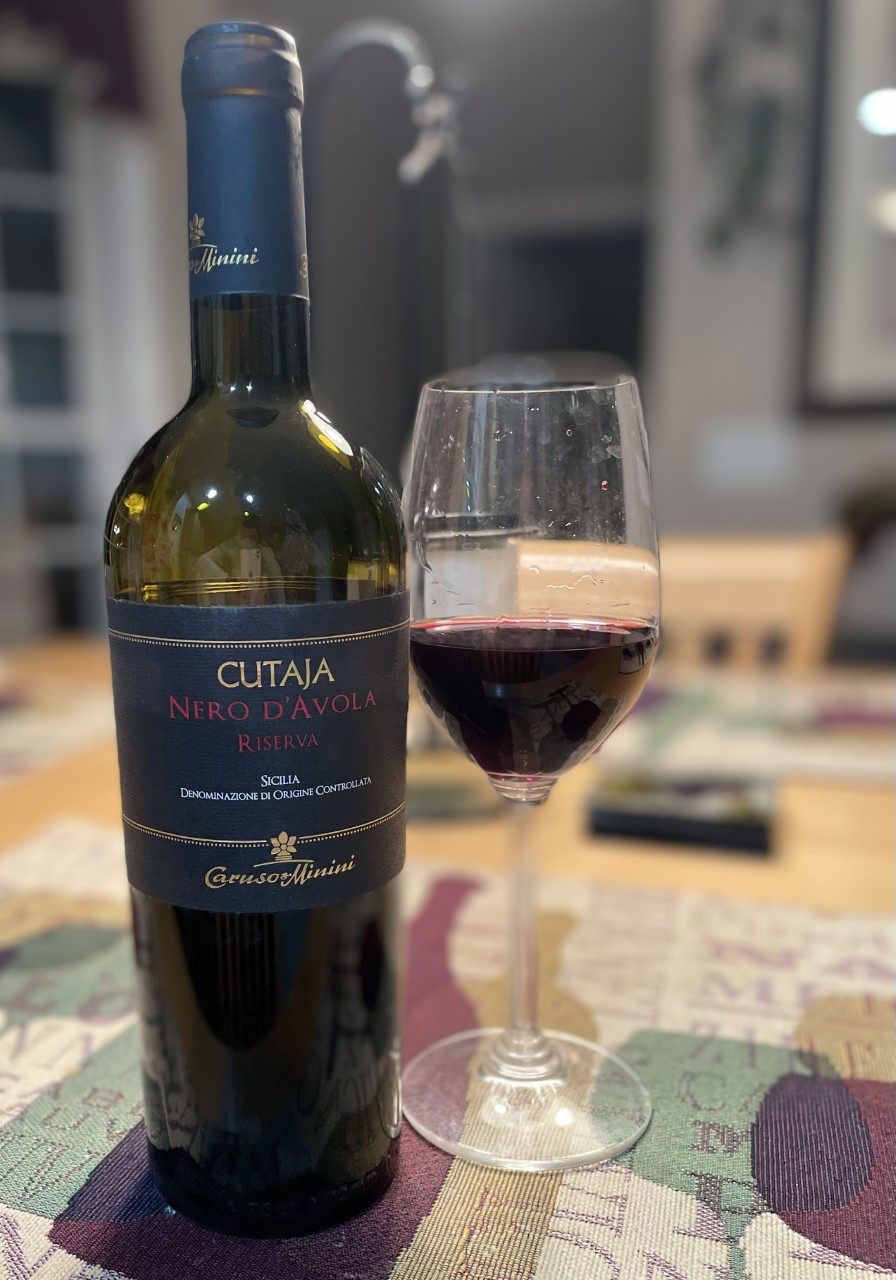
2015 Caruso & Minini Nero d'Avola Riserva

The wine “Cutaja” is named after the family vineyard as well as the round, smooth stones called “cuti” that are present in the vineyard in the area of Mazara del Valla past the gravel banks of the river.  This wine was deeply ruby colored with some garnet undertones.  Aromatics of plums, jammy blackberries and chocolate.  On the palate this wine was full-bodied and smooth and silky with nice acidity and a touch of tannin.  Rich fruits continued through to the lingering finish.  14% ABV 

cuti stones in terroir of Sicilian wine

The Pairing with Nero d’Avola 

I always think of eggplant when I think of Sicily.  Sicilian cuisine is labeled as “dinners for the rich and food for the poor” by Giuseppe Pitre, scholar and folklorist of Sicily. Diets rich in bread, nuts, olives, beans, pasta, fruits vegetables and of course seafood.  I chose to pair the Cutaja Nero d’Avola with a stack of eggplant layered with ricotta cheese and sauce which paired nicely.  This wine could also easily stand up to some heavier meats as well and pasta dishes.  

eggplant parmesan stacker paired with nero d'avola


Saturday, January 14, 2023

The Great Grapes of Sicily

Sicily is one of the fascinating wine regions of Italy, although we could probably make that statement for many others as well.  Sicily is Italy’s largest island and has a rich history of various cultural influences from Greeks and Romans to Phoenicians, Arabs and more.  These influences can be seen throughout Sicily’s architecture, food and wine to name a few.    

terroir of western Sicily in Trapani
Western Sicily in Trapani

Sicily’s unique terrain of coastal Mediterranean influences lined with pristine beaches to hills and Italy’s most active volcano, Mt. Etna, along with surrounding islands to include Pantelleria and the Aeolian Islands that contain additional active volcanos like Vulcano and Stromboli.    

terroir of Mt. Etna wines
Landscape of Mt. Etna
What draws me to Italian wines are the indigenous grapes and the traditions and styles of winemaking passed down from generation to generation.  Sicily’s wines are produced about 80% from native grapes and white wines lead the charts at 60% of the island’s production, mostly found on the western side.  The eastern side of Sicily is more red wine based.   

Sicily’s White Grapes 

There is a vast array of white grapes that you can find produced in Sicily, including some international varieties as well, but there are a number of them that lead the way in production.  These grapes are Catarratto, Carricante, Grillo, Inzolia, Zibibbo and Malvasia di Lipari.   


Catarratto is the most widely white grape planted in Sicily and is primarily planted around the western side of Sicily in the province of Trapani.  It is an ancient grape and one of the oldest of Sicily.   This was once used as the primary base in the fortified Marsala wines.  It’s a grape that produces large yields and because of that is sometimes exported in bulk or produces every day wines or is used a blending grape.  It is said to be genetically related to the grape, Garganega, of northern Italy used in producing Soave wines.  Catarratto typically produces, dry, light bodied wines that have good acidity with citrus notes. 

Catarratto grapes of Sicily
Sourced from the Consorzio Etna DOC

Grillo is a grape that wasn’t prevalent much before the 19th century, but over time has become the primary grape used in produced Marsala slowing replacing Catarratto.  Grillo’s skins and characteristics make it a great grape for producing Marsala.  It has great color, a nuttiness and a tendency to be a grape that can oxidize.  There are many producers that are also using this grape to make still wines that a creamier mouthfeel with tropical notes.   


Carricante’s home is found on the slopes of Mt. Etna climbing up to high altitudes.  Although it may not be labeled as such, if you see wines labeled Etna Bianco Carricante will be the primary grape used.   It is a late ripening grape that is known for its heightened acidity levels.  It produces dry, crisp wines with citrus and herbal notes.   

Carricante grapes of Sicily
Sourced from the Consorzio Etna DOC

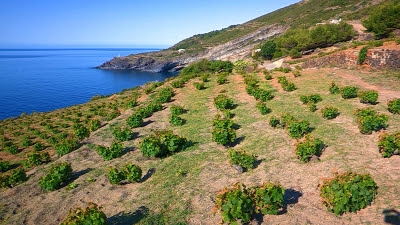
The last 2 white grapes I’m sharing today are typically found in Sicilian dessert wines, but can also be produced in a dry style.  Zibibbo, which I shared on last week’s blog with Donnafugata’s Ben Rye, is also known as Muscat di Alexandria.  It seems from the Arabic word zabib, which means raisened or dried grapes, which is how this wine is produced when produced as a dessert style wine as the grapes are dried out on mats.  You will mostly see this wine grown on the island of Pantelleria found on the western coast off the northern tip of Africa.   

Passito di Pantelleria wines
Sourced from the Consorzio di Pantelleria

The other white dessert style grape is Malvasia di Lipari.  This is grown on the volcanic Aeolian islands north of Sicily.  Lipari is actually the largest of Sicily’s islands.  Malvasia is produced in a passito style and is found under the Malvasia delle Lipari DOC with a sweet touch of apricots and honey.  Another sipper after an evening meal. 


Sicily’s Red Grapes 

When it comes to Sicily’s red grapes, Nero d’Avola leads the pack.  If you’ve ever shopped for Sicilian wines this is probably the one you’ve come across the most. The grape is named after the town of Avola found on the southeastern side. It is also known as Calabrese, which stems from the Sicilian dialect, Calavrisi. Nero, means black, and is perfectly named for the deep color it lends to the glass. A medium to full bodied wine with high alcohol and juicy acidity. It can have milder tannins with red and dark fruits, pepper and spice. This wine can be found blended with Frappato in the Cerasuolo di Vittoria DOCG wines, the only DOCG of the island. 


There are 2 Nerello grapes that are typically blended together, Nerello Mascalese and Nerello Cappuccio. These are both grapes that are native to Mt. Etna. Nerello Mascalese is the primary grape of the area and 2nd most planted red grape in Sicily. The name derives from the town of Mascali on the eastern side of Etna. It is a late ripening grape that is lighter colored, but carries good acidity, high alcohol with earthy characteristics along with red fruits, some spice and minerals. Mostly you will find these grapes labeled under Etna Rosso wines. Nerello Cappuccio on the other hand is not as prevalent and is mostly to add rich color to its counterpart and helps soften the wines.  

Nerello Mascalese grapes of Sicily
Sourced from the Consorzio Etna DOC

Frappato is a great red wine that depending on the producer is produced alone or blended with other grapes. It is mostly grown around Vittoria in the southeastern part of Sicily. It is a beautifully perfumed with that is light in body with lower tannins and juicy acidity. If you’re sometimes looking for a red in the summertime that doesn’t pack a heavily bodied punch then give Frappato a look. 


Lastly, the Perricone grape I really came to love on my last visit to Sicily in 2019 before the pandemic hit. Perricone is a grape that has been around since before phylloxera, but did at one point face extinction like many other grapes of Italy.  A number of producers that are now working with it of which I’m thankful for. It is also known as Pignatello and is a grape that gives great color, tannin and texture with red and dark fruits along with herbal notes. As mentioned before you will see this blended with Nero d’Avola often, but there are producers that make Perricone on its own seen in my previous post on Firriato’s Perricone. 


What are your favorite Sicilian grapes?