Friday, March 4, 2022

The Sustainability Behind Sicily's Principi di Butera

This month our Italian Food, Wine and Travel group (#ItalianFWT) is exploring organic, biodynamic and natural wines hosted by Katarina of Grapevine Adventures.  I'm adding a little flair to it featuring a winery in Sicily, Principi di Butera, that is practicing sustainability.  Since spring is around the corner I'm sharing one of their wines, the 2019 Diamanti Grillo, that has me craving the nicer days ahead as we slowly creep out of New England's winter.

What is sustainability when it comes to winegrowing?  There are a number of different ways a winery can practice sustainability.  It's a way in protecting the environment including the earth and air, conserving water and energy, water management, increasing biodiversity, reducing pesticides and preserving the ecosystem for the future.These practices take place within the vineyards themselves as well as the winery.  In order to be certified, a winery must follow specific criteria and have their farming practices evaluated. 

Does that mean that all sustainable wineries produce wines that are organic or biodynamic?  Not necesssarily.  It can happen, but just because a winery may be certified in one area, for example biodynamic or organic, does not mean that are also sustainable. 

The Winery ~ Principi di Butera 

The Principi di Butera winery surrounds an ancient courtyard that belonged to the 1st Prince of Sicily, Prince of Butera, Ambrogio Branciforte.  It was bestowed to him by King Philip II of Spain  in 1543.  The estate is located in the Caltanisetta province located in the southeast part of Sicily just 2 hours outside the capital of Sicily, Palermo.  

The area and it's soils are loaded with minerals and are mostly limsteone with clay.  It is set only about 6 miles from the Mediterranean coastline so they experience the hot, dry sun along with sea breezes with great diurnal swings allowing for ideal grape growing.  The estate occupies almost 800 acres with 420 acres dedicated to vines running east to west.

Here are some ways in which Principi di Butera practices sustainability:

  • Use of green manure, the process of burying specific crops to increase the fertility of the soil
  • The fertilizers used are organic
  • Weeding does not take place
  • They use a defense method to protect the spread of parasites in the vineyards
  • Preserves local flora and fauna by maintaining around 120 acres of farming land and pastures along with about 60 acres of olive groves that are all organic.
  • Use of a rainwater collection system when irrigation is necessary

The winery was acquired in 1997 and is know owned and operated by the well known Zonin brand.

The Wine

The wine I'm sharing today is based on the Grillo grape.  Although it can be find throughout Italy, Grillo calls Sicily home.  It is a cross between the Catarratto and Zibibbo (also known as Musut di Alexandria) grapes.  It was a grape that once faced extinction.  It was widely used in the production of Marsala until it hit a decline in the 60's and was being replaced by more productive grapes.  Thirty or so years later it was revived as a dry wine.  
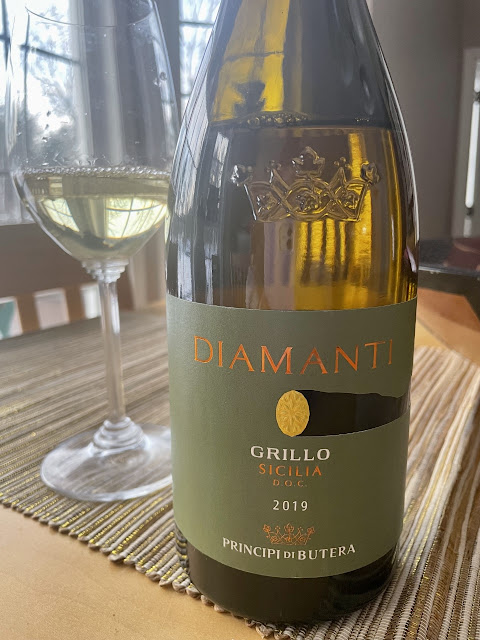
2019 Feudo Principi di Butera Diamanti Grillo Sicilia DOC
The 2019 Feudo Principi di Butera Diamanti Grillo Sicilia DOC is made from 100% Grillo.  It's fermented in stainless steel and spends about 4-6 months on the lees with a few more months in the bottle.  If you dig Sauvignon Blanc like I do you will want to give this wine a try.  A very pale straw color in the glass with a hue of green.  A fragrant nose of citrus and pineapple with a hint of pear.  Mouthwatering acidity through the palate with mostly citrus and apple notes.  On the back palate I also got a slight creaminess and hint of vanilla, possibly from the lees. Salinity showing up and rounding out the finish.  Just a lovely, easy drinking and refreshing wine.  ABV 12.5% SRP $16.99 

I cheated this week and picked up a roast chicken, but brought it home to chop up to make a homemade chicken pot pie to pair with this wine.  Delish!

Join our #ItalianFWT group live on Twitter this Saturday @ 11am EST as we chat about Italian organic and natural wines.  Read on for some more Italian food and wine suggestions.

Nicole at Somm’s Table will share “Cavalleri Franciacorta with Braised Collard Greens and Polenta”

Wendy at A Day in the Life on the Farm will share “Discovering Ziobaffa Wines”.

Camilla at Culinary Adventures with Cam will share “With an Ethos of Quality and Sustainability: ZIOBAFFA Pinot Grigio Terre Siciliane IGT + Braised Celery Over Farro Couscous

Susannah at Avvinare will share “Tuscany’s Querciabella Leads the Way on Vegan Wines

Gwendolyn at Wine Predator will share “La Maliosa Saturnia Biodynamic Natural Wine: Red, White Native Grapes Paired with Pizza #ItalianFWT

Katarina at Grapevine Adventures will share “3 Wines Going From Organic To Natural”

*This wine was provided as a sample, but opinions are always my own.

Friday, February 18, 2022

What's the Difference: Montepulciano of Abruzzo and Montepulciano in Tuscany?

Between finally getting over covid the last couple weeks and recovering from the congestion, I've yet to have some wine that I could taste to share with you all.  I figured this was a perfect time to share some practical information on Italian wine that you may find useful.

Have you ever been in the market for Italian wine and noticed there are red wines named Montepulciano d'Abruzzo and also wines named Vino Nobile di Montepulciano or even Rosso di Montepulciano?  What is the difference between these two wines since they both are labeled with Montepulciano?  There is actually quite the difference between them so let's dig in.

Montepulciano from Abruzzo

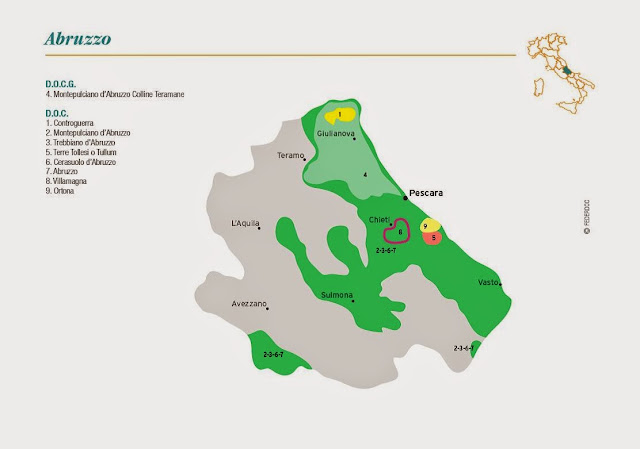
Montepulciano d'Abruzzo wines hail from the region of Abruzzo located in central Italy on the eastern coastline along the Adriatic.  The grape that primarily makes up these wines are based on the Montepulciano grape.  This is a native red grape to the Abruzzo wine region and is found as a baseline in many of the red wines of this area.  

Abruzzo wine region with Montepulciano d'Abruzzo DOC
Copyright of Federdoc

Montepulciano is a thick-skinned grape that needs the right climate and is a late harvesting wine as well.  It produces wines that are deeply ruby colored, fuller bodied with a higher alcohol and tannin profile.  You'll notice more red fruit notes in these wines as well.  

The Montepulciano d'Abruzzo DOC appellation was the first DOC in Abruzzo established back in 1968.  It encompasses a vast part of the region so there is much variation in the styles of wines from producer to producer.  Some of the best are going to show much more complexities leaning towards a fuller body with higher alcohol and tannins present.  This DOC spans from the coastline and hills from the Marche region in the north to Molise in the south.  The wines produced under this DOC must be a minimum of 85% Montepulciano.

Here are some prior posts featuring some Montepulciano d'Abruzzo wines:

Montepulciano in Tuscany
Now what does that mean for those labeled Vino Nobile di Montepulciano or Rosso di Montepulciano?  So much so that we're in a totally different region into Tuscany.  These wines also aren't even based on the Montepulciano grape.  They are based on Sangiovese.  

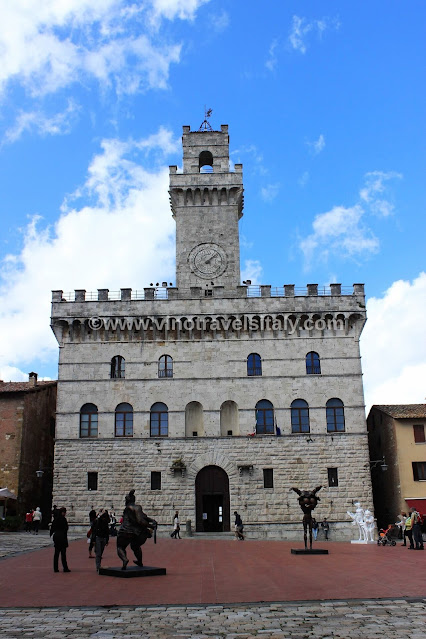
Montepulciano is such a great Tuscan town that I've had the privilege to visit a few times now.  It's a medieval hilltop Tuscan town located in the southern part of Tuscany in the province of Siena.  The wines span mostly around the town of Montepulciano on the western side of the area, but are separated by the eastern part of Valiano by the Val di Chiana.  
Town of Montepulciano in Tuscany
Montepulciano
The Vino Nobile di Montepulciano DOCG wines and the lesser stringent restrictions of the Rosso di Montepulciano DOC, are primarily based on the Sangiovese grape, also known as Prugnolo Gentile, requiring a minimum of 70%.  

As you can see we are talking two different regions, two different grapes, and two very different wines both great in their own way.  Check out some of my prior posts on wines from Vino Nobile di Montepulciano and Rosso di Montepulciano.


Friday, February 4, 2022

Pinot Nero is in Abundance in the Oltrepo Pavese

This month for our theme for our Italian Food, Wine & Travel group (#ItalianFWT) is hosted by Susannah of Vigneto Communications as she takes us to the Oltrepo Pavese wine appellation in Lombardy. When one thinks of the great wine regions of Italy I’m sure the Lombardy wine region isn’t the first that comes to mind. If you’re a fan of pinot noir the Oltrepo Pavese is a region that one must seek out as it hosts one of the largest areas under vine for Pinot Nero.  

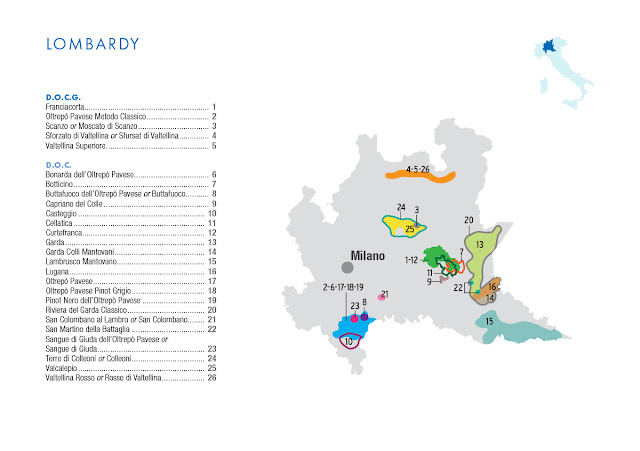
Map of Lombardy wine region
Map of Lombardy wine region ~ copyright of Federdoc

The Area ~ Oltrepo Pavese 

The Oltrepo Pavese is located along the 45th parallel where you also find the great wine regions of the world producing Pinot Noir including Burgundy and Oregon. It’s influenced by the Mediterranean climate of the Ligurian Sea to its south and the continental climate of the Po River and mountains in Piedmont. There are over 32,000 acres under vine with over 160 producers and 1,300 growers.  


Outside of Italy, the Oltrepo Pavese is also the third largest area for Pinot Nero in Europe after Champagne and Burgundy. It has been growing there since the 1800’s. The wine produced in the Oltrepo Pavese occupies 60% of Lombardy’s total wine production, but almost half of it is kept within Italy. Its primary grapes found throughout the area are Pinot Nero, Riesling, Bonarda and Croatina that may be blended with some other native varietals.  


The Winery ~ Ca’ Di Frara 

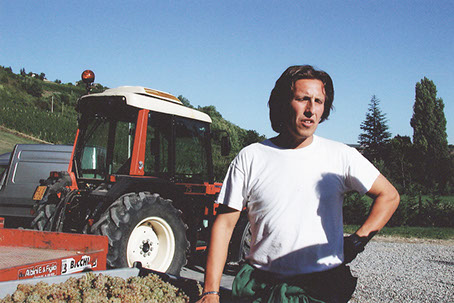
The Ca’ Di Frara winery is the local dialect for Casa Ferrari, named after the small hamlet where it is located near Mornico Losana. The winery was founded back in 1905 by the great grandfather, Giovanni Bellani, of today’s 3rd generation family member that runs the winery today, Luca, along with the assistance of his brother Matteo. The winery is set in the hillsides receiving mild winters with warm and windy summer temperatures.  

Luca Bellani of Ca' Di Frara
Luca Bellani ~ copyright of Ca' Di Frara

There are a few types of soils where the grapes of Ca’ Di Frara are grown. Those grown in the Mornico area are high in clay, which assist with color and deeper aromas and flavors. This is where their Pinot Nero, Croatina and Barbera are grown. In the Oliva Gessi area the soils are comprised of chalk and limestone where their Pinot Grigio, Riesling and Pinot Nero for their sparkling wines are grown. 

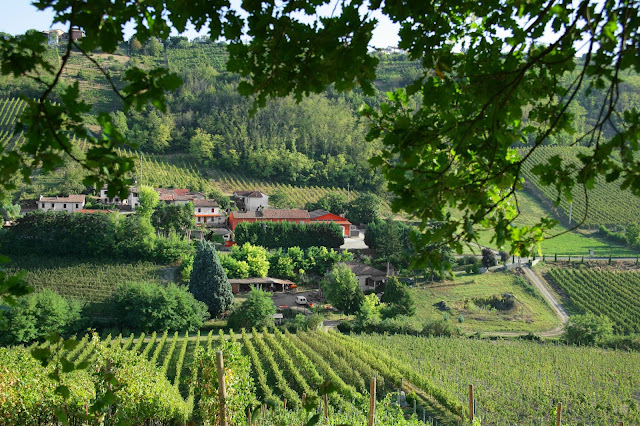
Ca' Di Frara winery
Ca' Di Frara ~ copyright of Ca' Di Frara
The Wine 

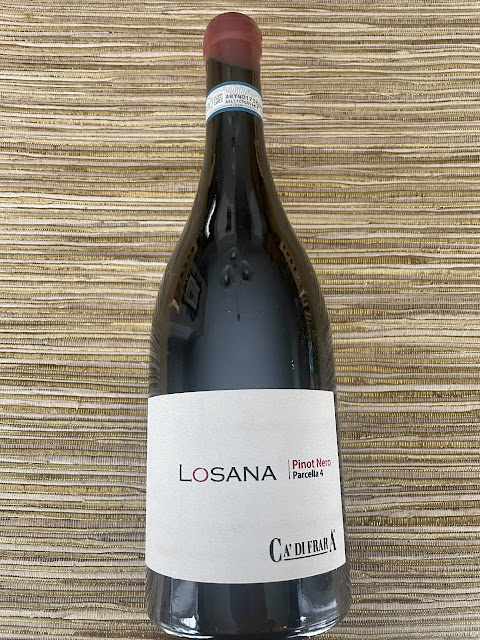
The 2018 Ca’ Di Frara Losana Pinot Nero dell’ Oltrepo Pavese DOC wine is made from 100% Pinot Nero. The general Oltrepo Pavese DOC was established in 1970 until there was a further breakdown of other specific varietals in later years including the Pinot Nero dell’ Oltrepo Pavese DOC in 2010. Wines from this DOC require at least 95% Pinot Nero. The wine spends 12 months in barrique with an additional 12 months in the bottle. The wine was deep ruby colored in the glass with garnet hues. A fresh bouquet of ripe raspberries on the nose with a hint of cocoa. This Pinot Nero was different than what I’ve typically been used to when it comes to pinot noir as I found it quite earthy. I was surprised by some of the firm tannin on this wine up front with lingering acidity in the back showing notes of raspberry and cherry. ABV 13.5% 

2018 Ca’ Di Frara Losana Pinot Nero dell’ Oltrepo Pavese DOC

I also have a sparkling wine from this area that I received to sample, but due to getting sick this week I’ll will have to delay in trying it until I’m back to normal.  


Join us for a live chat on Twitter this Saturday at #ItalianFWT @ 11:00 am EST. In the meantime join my fellow Italian food and wine lovers as they take you through their journey to the Oltrepo Pavese. Have a great weekend! 

  • Payal of Keep the Peas shares “Just Now Discovering Oltrepò Pavese 
  • Camilla from Culinary Adventures with Camilla adds Second Pours of Oltrepò Pavese Wines with Braised Short Ribs and Puff Pastry” 
  • Linda from My Full Wineglass brings “Flying under the radar with an Oltrepò Pavese sparkling rosé” 
  • Terri from My Good Life dishes about “Stone Crabs with Oltrepò Pavese.” 
  • Martin from Enofylz showcases “A Taste Of The Unsung Wines of Oltrepò Pavese” 
  • Deanna from Winevore posts “Wine for the Priest! from Oltrepo Pavese, Italy” 
  • Jeff from Food Wine Click! waxes about the “Surprising Wines of Oltrepò Pavese” 
  • Rupal from Syrah Queen post “Oltrepò Pavese Wines -One of Italy’s Best Kept Secret” 
  • Gwendolyn from Wine Predator showcases “2 Pinot Nero from Oltrepo’ Pavese #ItalianFWT” 
  • David from Cooking Chat reflects on “Tasting and Pairing with Oltrepo’ Pavese Wines” 
  • Wendy from A Day in the Life on the Farm checks out “Cheesy Vegetable Lasagna paired with Oltrepo Pavese Wine” 
  • Liz from What’s In that Bottle suggests we “Check Out “the Other Side of the Pó” for Tasty Italian Wines “ 
  • Lisa from The Wine Chef writes “Off The Beaten Path: Oltrepò Pavese, A Wine Region to Know About.” 
  • Susannah from Avvinare, writes about “Wine Treasures To Be Found in Oltrepò Pavese.'”

*This wine was provided as a sample, but opinions are always my own.